
Written and edited by Mark Clark, Kenneth Hardin, and Gregory Harris, with assistance from Mariann Kurtz and Janice Theriot.
This article first appeared in the September 17, 1987 issue of The Louisville Cardinal.
The Louisville Cardinal’s origins inevitably trace back to the dedication and vision of Samuel E. Hymen, who began working toward an independently-minded student publication at the University of Louisville ten years before The Cardinal first appeared in 1932.
Groundwork for the creation of a student weekly was laid in I922 when a group of U of L students, lead by Hymen, established a Journalism Club.
Although the primary intent of the organization was to generate interest in creating a journalism chair at the University, the group’s debates and discussions solidified many of the professional and ethical convictions which would become the very soul of future publications.
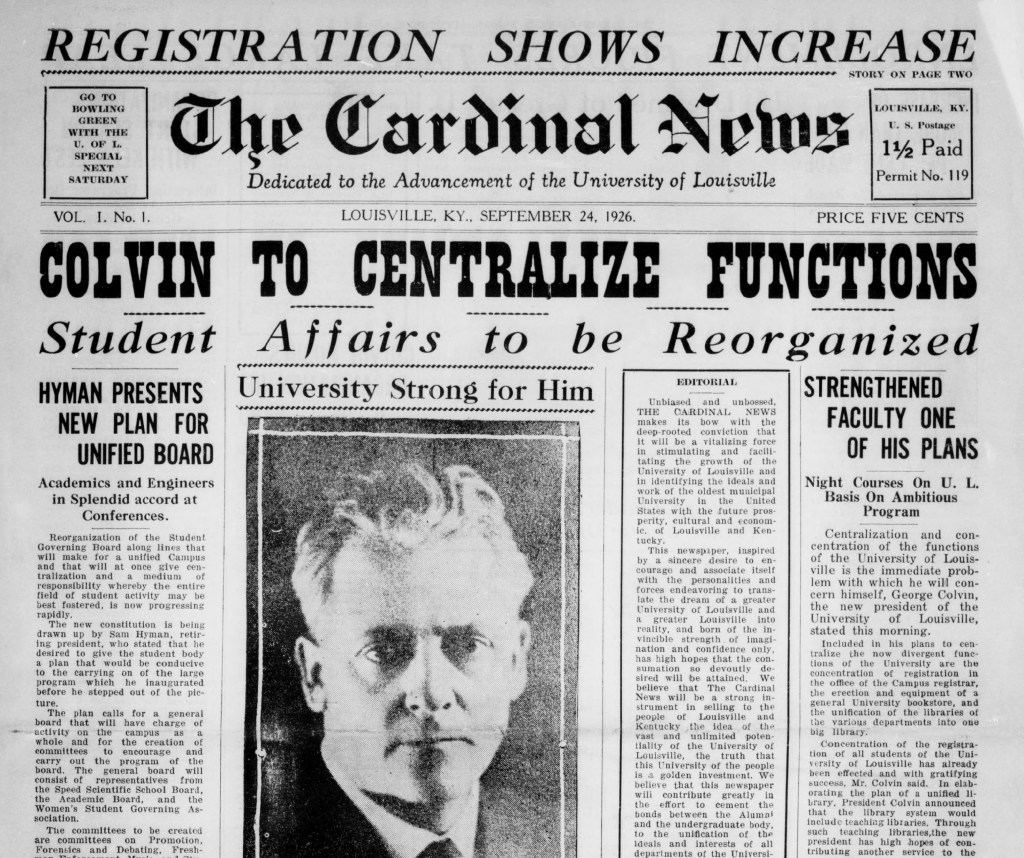
Hymen was instrumental in the creation of The Cardinal’s earliest predecessor, The Cardinal News, which made its first appearance in the fall of I926.
Operated in conjunction with the Journalism Club, The Cardinal News produced 31 weekly issues until it was discontinued on June 3, I927. Students staffed and edited the paper, which sold for five cents and supported itself through advertising sales.
In an editorial on the Sept. 24, 1926 premiere issue’s front page, editor and general manager Hymen declared the ambitious mission of the fledgling publication.
“Unbiased and unbossed, The Cardinal News makes its bow with the deep-rooted conviction that it will be a vitalizing force in stimulating and facilitating the growth of the University of Louisville and in identifying the ideas and work of the oldest municipal university in the United States with the future prosperity, cultural and economic, of Louisville and Kentucky … And so. we dedicate this weekly newspaper to freedom, a greater U of L, a greater Louisville and Kentucky.”
Topics reported by Hymen and his staff varied widely. Articles addressed national and international issues as well as the emergence of U of L football under Coach Tom King and star player Fred C. Koster and theatrical productions produced by drama coach Boyd Martin.
Perhaps the most controversial news item which occurred during the brief existence of The Cardinal News was the coverage of the stormy administration of U of L President George Colvin, who served from 1926 until his death in office in 1928.
Colvin’s policies lead to the resignation of Louis D. Gottschalk, a U of L history professor who later received recognition at the University of Chicago as a historian of the French Revolution.
Gottschalk’s departure highlighted a series of disagreements between President Colvin and many faculty members, some of whom accused the President of antisemitism, favoritism, and anti-intellectualism. Hymen and his staff faithfully covered these episodes. Editorially, The Cardinal News criticized Colvin and his backers.
Other events covered by The Cardinal News which would have enduring impact on the University community included construction bids for the Administration Building, the growing interest of United States Supreme Court Justice Louis D. Brandeis in the University’s School of Law, and the initiation of a U of L endowment campaign.
The U of L News followed The Cardinal News with its first issue on Feb. 24, 1928. The new Faculty Committee on Student Publications exercised final control over the student paper, which was distributed free, but lacked the independence of Hymen’s earlier creation.
In the first issue, editor William Ray acknowledged the cooperation of President Colvin in establishing The U of L News, but also expressed appreciation for the “advice, aid, and material assistance of Samuel E. Hymen, who had been sincere and honest in his convictions.”
The U of L News steered clear of the Colvin controversy, but when the President died it criticized “those few hoodlum fools on the faculty” who reportedly “gathered for a celebration upon hearing of the death.”
In May, 1929, the editors complained that they had not received the amount of support hoped for: the paper was discontinued in 1930.
The present Cardinal first appeared in 1932 and has ran continuously since that time. The new paper operated under a Board of Student Publications, created by President Raymond A. Kent, which originally included three faculty members and the editor and business manager of each student publication.
Although The Cardinal was distributed free of charge, it was financially solvent through advertising sales, at least for the first several years.
In 1934, the editors even suggested turning over their excess funds to The Thoroughbred, the ailing University yearbook. In 1936, the senior issue of The Cardinal replaced the annual, which missed several years of publication during the 1930s and World War II.
Forbidding members to advertise in school publications, the Louisville Retail Merchants Association hurt The Cardinal during the ‘30s, but the newspaper, unlike the yearbook, managed to continue without interruption.
From the beginning, The Cardinal reflected student opinions, although it may or may not have been representative. In 1932, for example, the paper became involved in a controversy surrounding football at the University.
Several letters to the editor signed “Agnes” criticized those who argued for a good football program to promote the school, but a reply called the anonymous writer “a lightweight from the neck up.”
In December 1932, the Cardinal announced new rules for fraternity and sorority dances, posted by Dean Hilda Threlkeld. Not only did the rules limit the number of unaccompanied men at each gathering (four to each woman), but also said “drunkenness or disorderly conduct” were “forbidden at future dances.”
The annual Cardinal joke edition became a regular item during the ‘30s. On February 10, 1933, the editors announced the upcoming comic issue and encouraged readers not to take offense.
The special issue appeared the next week, printed in red ink. It contained descriptions of a university as they might have been written by various American authors, including Sinclair Lewis. The paper reported that Lewis would write the sentence “Elmer Gantry surveyed the ugly red brick buildings which raised their drab shapes into a gray, winter sky.”
Later, the Louisville Herald-Post ran an editorial criticizing flashy student publications, but did not mention The Cardinal by name.
The early Cardinal was a vigorous student weekly with editorial opinions on local, national, and international issues. In 1936, editor Lewis M. Cohen wrote that during his term he had “tried to arouse a lasting social consciousness.”
The newspaper was strongly critical of an American Legion investigation of radicalism on campus, promoted isolationism, and argued against preparedness during the ’30s.
In 1937 U of L President Raymond A. Kent censored the paper due to what he called factual inaccuracies in a story. In his 1936-37 annual report, Kent said he only demanded that the paper tell the truth and keep the proper decorum, and that censorship had resulted because he believed the first principle had been violated.
Generally, President Kent defended the right of The Cardinal to take unpopular positions on controversial issues. The Cardinal held to its isolationist posture even after Germany invaded Poland on Sept 1, 1939. On May 31, 1940, the University’s Board of Trustees held a special meeting to discuss the morning s issue of The Cardinal, which claimed that an “Anglo-French Fifth Column (had) invaded Louisville.”
The paper charged that this group sought to aid the mother country, Britain, just as the National Socialists in Germany supported the Fatherland. In November, 1940, The Cardinal announced a change in editorial focus from national and international topics to university issues. By 1944, the paper had become a vigorous supporter of war loans. It also advocated an anti-poll tax bill and “many concrete ideas for post-war planning.”
Society was somewhat more placid following the war, but The Cardinal remained active in a variety of issues.
When the Louisville Municipal College, a black liberal arts school affiliated with U of L, closed and blacks were admitted to the University in 1950-51, The Cardinal decried the problems of operating an integrated university in a segregated city. Black students, for example, could not be admitted to swimming classes that met at the local YMCA.
However, the paper was less vocal during the early ‘50s than it had been during the ‘30s. A series of articles in 1952 reported on local watering holes such as Sherman’s Tavern, where “the favorite college order” was “the ten-cent local draft.”
The tone of The Cardinal changed gradually during the late ‘50s and early 1960s. In October 1960. some local residents complained to U of L President Philip G. Davidson that a recent Cardinal article had shown a “sick, beatnik sense of humor.”
One observer was even moved to say that “the printing of restroom wall inscriptions in the campus paper causes me to wonder if perhaps freedom of the press is a mistake.”
The late ‘60s and early 1970s, a period coinciding with general student rebellion in the United States, brought changes in The Cardinal which shocked many old-line liberals.
The 1969 April Fool edition of the newspaper caused President Woodrow M. Strickler to suspend publication briefly following the use of what The Courier-Journal called “a couple of poverty-stricken four-letter words.”
Although the suspension was brief, some believed Strickler had acted too harshly, while others accused the President of showing weakness. A Louisville Times editorial said the University had exercised “grace and good sense” in the matter.
During the ‘70s, the April Fool issue of the paper continued to be controversial, as in 1977 when the joke edition announced the death of President James Greer Miller.
The April Fools situation came to a head on April 13, 1979, when The Cardinal, under the direction of editor Tom Murray, released a fictitious issue bearing a three-column photograph of several hundred nude people on its front page. The accompanying cutline read:
“Still hope: World leaders yesterday grappled with last minute negotiations for the nuclear peace in front of U.N. headquarters in New York. Negotiators spumed offers of clothing explaining that clothes would only irritate their charred flesh.”
Inside stories included a report of U of L’s entire football team being arrested on drug, sodomy, and subversion charges. Only one ad in the issue had not been altered, which resulted in the total collapse of the paper’s advertising credentials.
The editorial page was topped with one-and-a-half inch high type spelling out a message described by Michael Wines of The Louisville Times as “a mere two words, one of which describes a sexual act in terms not generally used in tearoom conversation.”
The issue drew immediate and infuriated response from many members of the University community, particularly football coach Vince Gibson, who remarked “this ain’t no April Fool. Read the calendar. This is April 13.”
Gibson retained local attorney Frank Haddad and swore to sue The Cardinal for defamation of character, but the lawsuit never materialized.
The Student Board of Communications passed a resolution disapproving of the issue and called for a retraction from Murray in the final edition of the year.
Murray refused, and along with his managing editor Don Floyd, was promptly removed from his post and replaced by editor-appointee Mark Grundy by Vice President for Student Affairs Edward H. Hammond.
Grundy produced the final issue, complete with retraction, but the incident was far from over. Murray and Floyd sued the University to be reinstated to their posts, claiming their first amendment rights had been violated. Defendants were listed as the U of L Board of Trustees, President James G. Miller, and Hammond.
During the proceedings, Murray referred to Hammond, with whom he had experienced no previous conflicts, as “one who doesn’t care if you live or die; he just wants to get the job done.”
On May 7, U. S. District Court Judge Thomas A. Ballantine ruled that Murray’s and Floyd’s rights had been violated, but since their terms as editors had already expired, he deemed their suit mute. By May 15, Ballantine had dismissed the case entirely.
In retrospect. Murray said the issue “never looked the way I wanted it to.”
As a result of the controversy, the Board of Student Publications examined means of relieving the University of legal responsibility for The Cardinal.
After the incident, Murray said his main goal in publishing the inflammatory edition was to move the paper closer to complete independence, admitting that he was “constantly bucking authority.”
Murray was particularly incensed by the actions of Student Government Association representatives on the student publications board. At the time of the conflict, the committee consisted of the editors of the four existing student media groups and six SGA delegates, who Murray claimed would censor many criticisms of student government before they could be printed in The Cardinal.
Murray became so concerned with The Cardinal’s lack of control over the material that went on its pages that he said the rest of the University community viewed his virtually helpless staff as a “bunch of heroin addicts and groupies.”
By the spring of 1979 Murray’s vision of an independent Cardinal had come to pass. The University relinquished all editorial control and legal responsibility for the paper. A yearly grant from the independent University Foundation replaced direct University funding, and The Louisville Cardinal was incorporated as a separate business entity.
Grundy and his successors faced the considerable challenge of re-establishing The Cardinal’s credibility, which had disintegrated during the April Fools episode. Grundy, who accepted the paper’s new independence despite opposing it initially, suspended publication of any joke issues. The last, and a much tamer, April Fools edition appeared on April 3, 1981, during the term of editor Gil Lawson.
The first standardized version of The Cardinal’s policies as an independent entity was established by 1982-83 editor Paul A. Long. Facets of the policies included an absolute separation of The Cardinal’s business and news departments and a clarification of the paper’s relationship with SGA.
Financial difficulties beset the paper during the term of Long’s successor, Jack Barry, leaving 1984-85 editor Larry Croom confronted with a serious budget deficit. Croom and the advertising staff responded to the crisis, and the paper finished the year in the black.
In the fall of 1985, editor T. L. Stanley created The Cardinal’s first policy and style manual, using policies created by Long as a foundation.
Throughout the years, The Cardinal has remained at least a partial barometer of student opinion. Its pages contain a record of student life at U of L not found elsewhere.
Other student publications, and even student newspapers have appeared at the University from time to time, but The Cardinal and its forerunners, The Cardinal News and The U of L News, have appeared more often and provided more depth than any of their rivals.
Since students create fewer historical records than faculty or staff members, student life is one of the most difficult aspects of a university’s history to document. Although The Cardinal is an incomplete record, without this 55 year-old diary of activities and opinions, the history of the University of Louisville would be much less complete.
Adapted from “The Cardinal: A Record of Student Life” (1980) by Dwayne Cox, associate university archivist, and “Will the Real April Fool Please Stand Up” (1981) by Dawn Yankeelov, Cardinal managing editor in 1980-81 and editor in 1981-82.
Thanks go to the staff of the University Archives and Photo Archives for their encouragement and patient cooperation.
To view the original article and more, go to
“Photo Gallery: The Louisville Cardinal Throughout The Years”

Leave a Reply